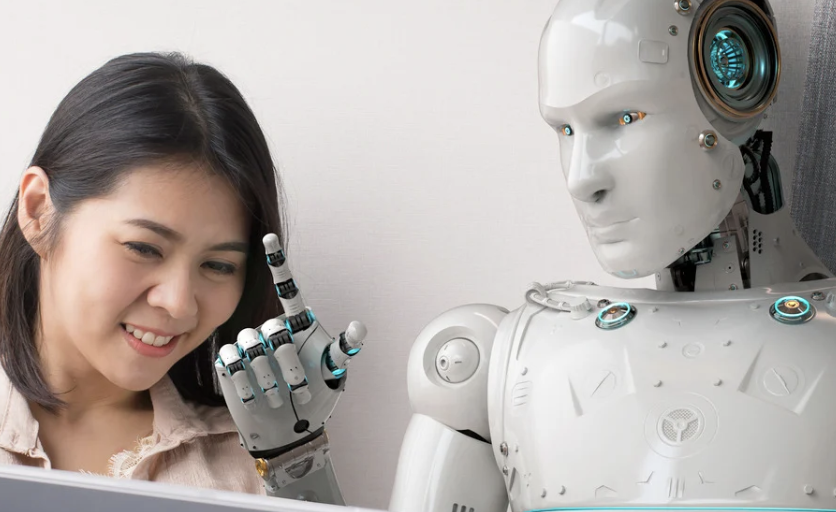
For the past two years, the conversation about AI has been dominated by what happens on a screen. We’ve obsessed over large language models (LLMs) writing essays, diffusion models creating art, and AI copilots summarizing our meetings. The entire revolution, as transformative as it has been, has remained trapped behind the glass of our monitors and smartphones.
That era is now officially ending.
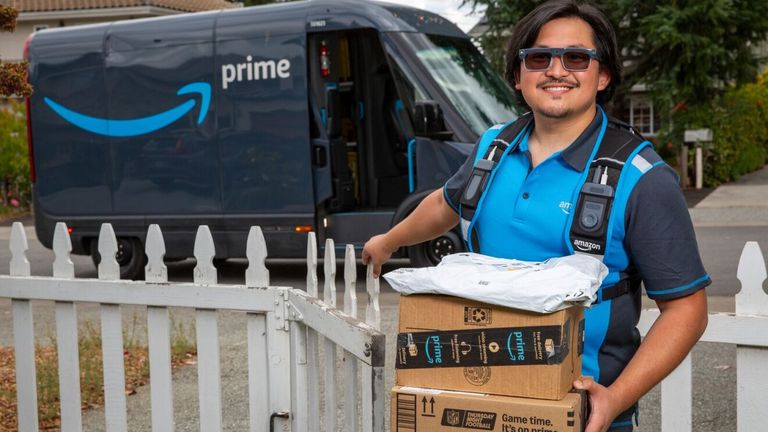
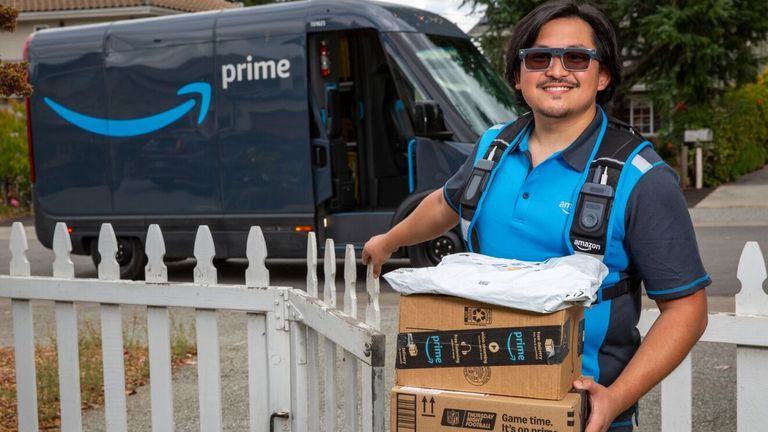
In a move that has been largely discussed as a logistics update, Amazon has begun testing AI-powered smart glasses for its delivery drivers. The stated goal is simple: to guide drivers more efficiently from their van to the customer’s exact doorstep.
It’s tempting to dismiss this as a minor efficiency hack—a futuristic replacement for the handheld scanner. But to do so would be to miss the most significant technology pivot of the decade.
This is not a story about a new wearable. This is the story of AI breaking free from the digital world and entering the physical one.
This initiative is the first mainstream, large-scale deployment of what is known as the “Augmented Workforce.” It’s the practical, real-world application of the “Industrial Metaverse” that tech visionaries have been promising. It signals a fundamental shift in human-computer interaction, moving intelligence from a tool we use to a layer we see.
The implications of this test go far beyond faster package delivery. They provide a blueprint for how AI will revolutionize every physical job on the planet, from the warehouse floor to the operating room.
Part 1: The Billion-Dollar Nightmare of the “Last 50 Feet”
To understand why Amazon is investing in AR glasses, you first have to understand the most complex and expensive part of their entire operation: the “last mile.”
More specifically, the “last 50 feet.”
The “last mile” broadly refers to the journey from a local distribution hub to your home. But the true bottleneck—the segment that bleeds the most time, money, and customer goodwill—is the short, chaotic walk from the delivery van to your front door.
Think about the sheer cognitive load placed on a driver:
Today, all of this is managed through a handheld scanner—a device affectionately known in the industry as the “digital clipboard.” The driver is in a constant, inefficient loop: look at the scanner, look at the world, look at the scanner, look at the package, look at the world. This “head-down” workflow is slow, error-prone, and a potential safety hazard.
Every second wasted in this loop, multiplied by millions of drivers and billions of packages, represents a colossal operational drain. Every package left at the wrong door is a customer service failure, a replacement cost, and a dent in the armor of Amazon’s reputation.
This is not a problem that can be solved with a better app. It’s a perceptual problem. Amazon needs to optimize the driver’s perception of reality. And to do that, they need to merge the digital and physical worlds.
Part 2: A Day in the Life of an Augmented Driver
Let’s paint a picture of what this new workflow, powered by AI-driven augmented reality (AR), actually looks like.
A driver pulls up to a complex street. She doesn’t look down at a mounted smartphone. Instead, she looks through her glasses.
In the Van: As she scans the packages in the back, the AI-powered glasses, equipped with a tiny camera, instantly recognize the correct package for the stop. A subtle green border might highlight it in her field of vision. She grabs it.
The First Steps: She steps out of the van. A simple, unobtrusive navigation arrow appears in her vision, overlaid on the real world. It doesn’t show her a 2D map; it highlights the actual walkway she needs to take. It’s a “yellow brick road” generated by AI.
Approaching the Building: The glasses, processing her view in real-time, identify the correct building number. As she enters the lobby, the AI accesses the building’s internal layout. The overlay updates: [TAKE ELEVATOR TO 3RD FLOOR. TURN LEFT.]
At the Door: As she approaches apartment “3B,” two pieces of information appear in her heads-up display (HUD):
Completing the Job: She places the package. The glasses’ camera automatically takes the proof-of-delivery photo, geotags it, and uploads it to the system. She might give a simple voice command: “Delivery complete.”
She is already walking back to her van before a traditional driver would have even finished fumbling with their scanner.
This is a “hands-free, head-up” workflow. The cognitive load is slashed. The AI is not a tool she must consult; it is a partner she perceives. It provides real-time, contextual intelligence. The time saved per stop may only be 30 seconds, but at Amazon’s scale, this translates into millions of hours and billions of dollars.
Part 3: The Tech Convergence—Why Now?
The idea of AR glasses is not new. Google Glass famously launched—and failed—over a decade ago. It was a solution in search of a problem, hampered by poor battery life, social awkwardness, and a high price tag.
So why is this different? Because Amazon’s initiative isn’t a consumer gadget; it’s a “B2B” (Business-to-Business) industrial tool. And it’s being deployed at the precise moment of a perfect technological storm.
This convergence of mature AI, practical hardware, and high-speed connectivity has made the “Augmented Workforce” economically viable for the first time in history.
Part 4: The Ripple Effect: From the Van to the Entire Economy
The true significance of Amazon’s AI glasses is not the device itself, but the precedent it sets. What begins with delivery drivers will not end there. Every industry that involves physical tasks and real-time information is on the cusp of this same transformation.
Imagine this technology applied elsewhere:
This is the “Augmented Workforce”: a new class of employee who is not replaced by AI, but enhanced by it. The AI handles the data retrieval, identification, and cognitive load, freeing the human to perform the physical task with superhuman efficiency.
Part 5: The Inevitable Dystopian Questions
We cannot, however, ignore the profound and unsettling implications of this technology. This “head-up” display is also a “boss-in-your-head.”
1. The Surveillance State: These glasses are a tool for total surveillance. The device sees what the driver sees. This means management can, in theory, monitor every second of a worker’s day. Every glance, every pause, every “sub-optimal” path is a data point to be analyzed. It’s Taylorism on steroids—the scientific management of a worker’s every physical movement.
2. The “De-Skilling” Dilemma: What happens to the worker’s own skills? If an AI guides your every move, do you become a “human-bot,” merely executing the AI’s commands? What happens when the technology fails? Does the driver, now fully dependent on the “yellow brick road,” even know how to read a map or navigate a complex building on their own? This technology could augment skills, or it could atrophy them.
3. The Ergonomic Unknowns: We are just beginning to understand the long-term physical and mental effects of “scanner neck” from handheld devices. What are the effects of wearing a data-processing computer on your head for eight hours a day, with information constantly flickering in your peripheral vision?
Conclusion: The Physical World is the Next AI Frontier
Amazon’s test of AI-powered glasses is a watershed moment. It represents the end of AI as a purely digital-world phenomenon. The revolution is moving from the desk to the doorstep.
For years, we have been told that AI would transform “knowledge work.” This initiative proves that its impact on “physical work” may be even more immediate and profound. The line between the digital instruction and the physical action is about to be erased, merged into a single, fluid motion.
This is not a far-future-of-work prediction. It is a present-day reality being tested on our streets. The Augmented Workforce is here, and it’s arriving one package at a time.